Through the use of the web, NPOs have tried to introduce new ways of expressing their core values and ideas. This is done to preserve relevancy in the ever-evolving digital age, where many other companies are competing for the attention and involvement of advocates. This is achieved by incorporating useable technologies and techniques to differentiate themselves.
Over time, the web has materialized as having a crucial role in the NPO world. This is because as the web evolved, many features have been used to make involvement in NPOs easier and more convenient, encouraging more people to connect with those organisations. As years pass, some of the web trends become common expectations, which might be difficult to achieve for organisations with limited budgets. In addition, it is becoming more essential for non-profit websites to update their websites more frequently – according to Network Depot (2024), only 68% of NPOs have re-designed their websites in the last 3 years, which is an issue as it makes them more vulnerable to cyberattacks and it is also inconvenient if their mission has changed in any way. Audiences select non-profits to support based on their own identity, as well as their emotional attachment to it therefore many NPOs create a branding that can elicit an emotional response from many people and consider volunteering for them.
In order to judge how much the web has been beneficial (or a disadvantage) for the NPO’s goals, I have looked at the perception of the web before its widespread and unavoidable usage, drawing comparisons to how it has evolved until now. Before the Internet, NPOs used to promote themselves through TV channels and print media – this made it more difficult for small organisations to stay afloat due to the cost associated with this type of promotion. Therefore, the Internet has significantly aided them in promoting their causes.
One important factor that affected the way that the web is structured is that computer screens have gotten larger over time, changing the way that the hierarchy of information is presented. An example of this is the fact that many websites in the late 1990s and early 2000s were left-aligned to accommodate the average dimension of the computer screen. This has changed how non-profit organisations present themselves via the Web because it puts restrictions on the layouts of the website and it further putstechnical limitations onto NPOs.
One way in which the web had a role in fostering creativity and innovation is through allowing CSS and JavaScript to evolve over the years to allow different techniques and functions to be added. During the Internet 1.0 era of the Internet, websites were much simpler and did not allow for the same complexity as the Internet does now.
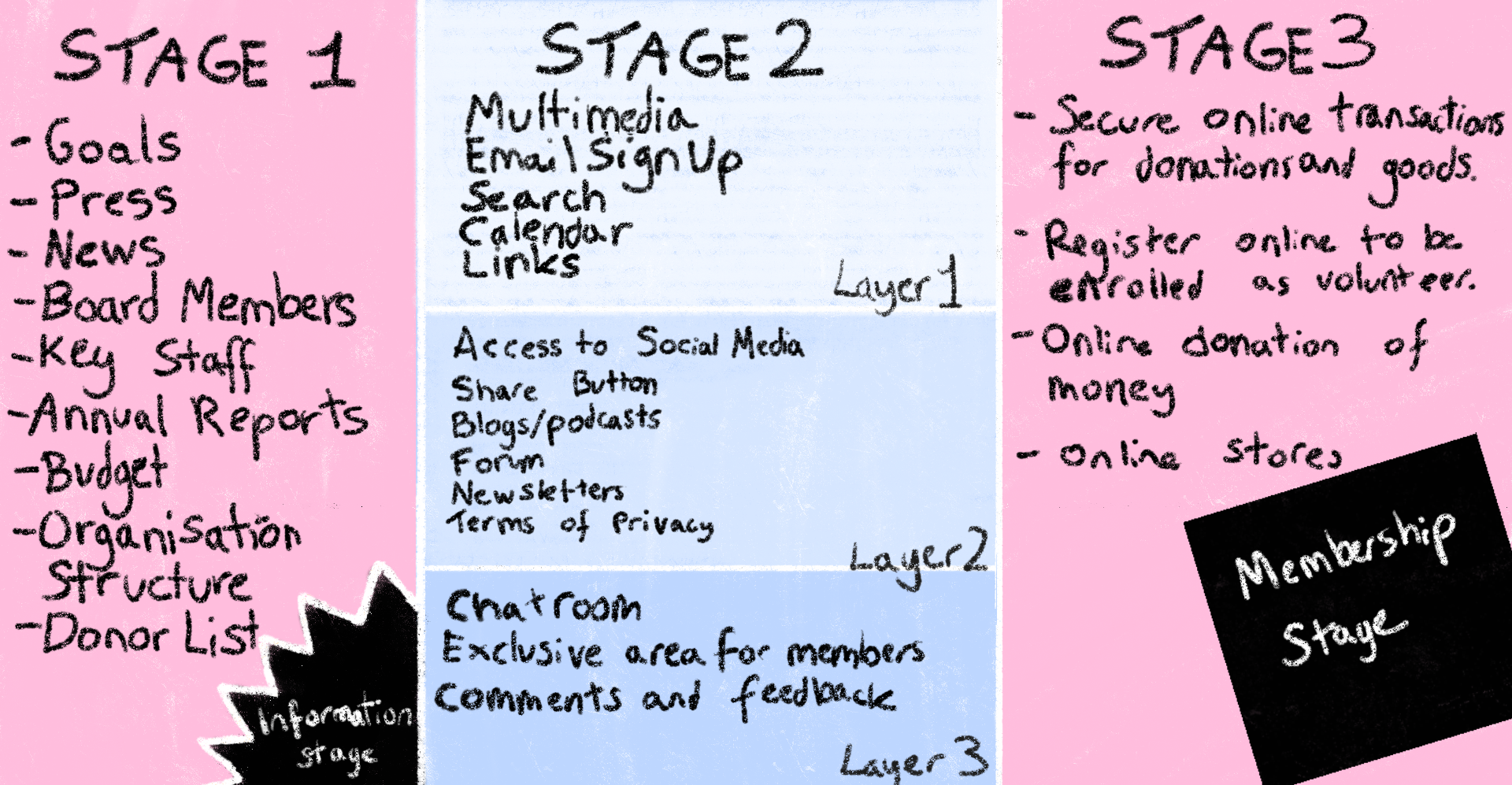
I have created a diagram of the EMEA stages of user engagement inspired by the journal written by Carrillo-Durán, M.V., Tato-Jiménez, J.L., Chapleo, C. and Sepulcri, L. (2023). This information presents how creativity and innovation shaped how NPOs present themselves digitally because it presents the different layers of interactivity that a person would have with an NPO, and which web features correlate to them.
Campaigns
The ASL Ice Bucket Challenge has changed how non-profit organisations approach campaigns because it utilized a fun challenge and used it for the funding of scientific research for the amyotrophic lateral sclerosis disease. This campaign has had a large impact on the NPO and scientific research industry because it brought awareness of a rare disease to millions of people. One way in which the success of this campaign could be applied nowadays is through combining the main goal (whether it is medical research or other good cause) to something unusual which the public could partake in to spread the word.
References
Network Depot (2024) Significant positive and negative non-profit statistics in 2024. Available at: https://www.networkdepot.com/significant-positive-and-negative-nonprofit-statistics-in-2024/ [Accessed 3/11/24].
CauseLabs (2024) Nonprofit websites are evolving: new trends to watch in 2024. Available at: https://www.causelabs.com/post/nonprofit-websites-are-evolving/ [Accessed 4/11/24].
Purkis, D. (2023) How the internet changed nonprofits. Available at: https://www.zeffy.com/blog/how-the-internet-changed-nonprofits [Accessed 4/11/24].
Simón, S.P., García‐Madariaga, J. (2023) Impact of emotional appeal on non‐profit advertising: a neurophysiological analysis. Journal of Consumer Behaviour, 23(1), 203–217. https://doi.org/10.1002/cb.2168.
Kang, S., Norton, H.E. (2004) Nonprofit organizations’ use of the world wide web: Are they sufficiently fulfilling organizational goals? Public Relations Review, 30(3), 279–284. https://doi.org/10.1016/j.pubrev.2004.04.002.
Greenberg, J., MacAulay, M. (2009) NPO 2.0? Exploring the web presence of environmental nonprofit organizations in Canada. Global Media Journal, 2(1). https://www.proquest.com/publiccontent/docview/888150026/fulltext/73776DCB2B1A46BAPQ/1?accountid=11528&sourcetype=Scholarly%20Journals
Carrillo-Durán, M.V., Tato-Jiménez, J.L., Chapleo, C. and Sepulcri, L. (2023). Enhancing non-profit engagement: the extended model of webpage engagement and adoption for strategic management. Humanities and Social Sciences Communications, 10(1). https://doi.org/10.1057/s41599-023-01980-9.
Vizard, S. (2014) The ice bucket challenge: one-hit wonder or the future of fundraising? Marketing Week. Available at: https://www.marketingweek.com/the-ice-bucket-challenge-one-hit-wonder-or-the-future-of-fundraising/ [Accessed 4/11/2024].
Leave a Reply