Research Overview
The emerging technologies project that I am creating will be centred around a fashion brand that is trying to encourage more people to be interested in their shows and to create discourse around emerging technologies being implemented into fashion more and in alternative ways. Additionally, another plan that I have for this project is for it to act similarly to exposure therapy for social anxiety, however with a more unusual take on it where the experience of being a model is not an experience that most people have in common therefore it might broaden their horizons and provide insight into the fashion world from the perspective of a model.
The emerging technology that I am mostly planning to use is virtual reality where the user will be wearing a headset in order to be fully immersed. I am planning on doing this through modelling the environment, models and audience in Blender and implementing it into a virtual reality scenario where the user is either just shown the surroundings or can walk through the world (although this can cause issues with user experience).
The target audience for this experience would be people who have any interest in fashion (the consumers, the researchers and designers), and are open to experiencing it in a virtual way. The age range of my audience would be between 25-40 as the experience would be more serious and it could help them reflect emotionally on their experiences with the fashion world and possibly overcoming (or how they already overcame) the anxiety that they have regarding the public.
The user experience of this project is meant to be slightly anxiety-inducing and unusual, my intention is to make this experience from the first point-of-view of a model walking down the runway, with many factors in the environment that could cause problems for the amateur model who is attempting to just do their job successfully. Some of the things that they would struggle with is the sheer amount of people in the audience, the status and stakes of the show, too many bright lights and extremely high pressure to perform perfectly.
Limitations, Accessibility & Ethics
Whilst emerging technologies offer a lot of ways to innovate the medium of design and technology, there are numerous issues that may discourage many users from considering implementing these technologies into their daily lives, regardless if they are the designer or the user. The physical limitations of this technology might be inaccessible or inconvenient for many users due to endless factors such as for example disabilities and financial reasons. The actual headset can pose many health risks such as eye strain and migraines if it is worn for too long consecutively, therefore when creating a VR experience, the different measures to avoid this should be implemented during the design stage.
Some of the ethical concerns of using emerging technologies include privacy and data collection, addiction, harassment, and many more as these technologies are often implemented into social media which causes an entire set of ethical issues. An example of an ethical issue that is specific for this project is being able to project your identity onto another financial class and ability status as the character that the user is playing as is meant to vaguely represent them in this situation, therefore there needs to be consideration into how that character is represented and how much information is shared to the user.
“VR fashion shows democratize this privileged consumption by making it available to everyone within the boundaries of virtual reality.” – Kim (2023).
This quote above explains the possibility that VR fashion experience have the ability to transform parts of the users’ identity when they are in the virtual world, and it needs to be implemented carefully as to not cause any culturally ethical issues that come with that ability.
UX Considerations
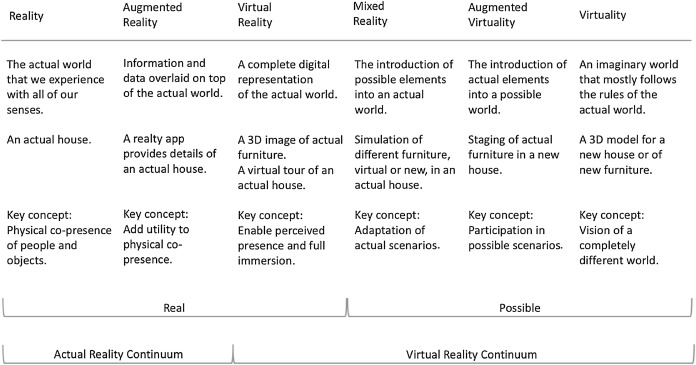
When designing a VR experience, it is incredibly important to consider the user experience above almost all else. If a VR experience is unplayable for the majority of people, its full purpose cannot be fulfilled. The diagram above presents the boundaries in between reality and virtuality, and they must be prioritized throughout the entire process of creating any virtual or mixed reality experience in order to avoid user confusion.
When considering the multimodal inputs, I have decided on allowing the user to use a hand controller and just pressing the buttons in order to steer the camera and walk. The user will be also tilting and rotating their head to view the surroundings as usual. One issue that I have had when planning this project is figuring out how to make the concept user-friendly as I did not want to cause motion sickness and lack of control for the player through just having the player move automatically. The reason why this was a struggle is that I have not found any examples of a VR experience where the user is a model, therefore I do not have any reference of an example that executed the UX well in this regard.
Another UX consideration that is important is ensuring that any movements and changes aren’t too rapid so that the user can process the changes and adapt to them instead of being startled by them which might affect the comfort of the user whilst playing. I have applied this to my project through re-thinking the decision to have the user be propelled along the route by the game itself instead of it being a user decision. This also allows the user to have control over their action in virtuality and fits better thematically as the user now has to ensure perfect timing in walking down the runway.
Existing examples of emerging technologies in fashion
There are numerous examples of VR, AR, MR and XR uses in the fashion industry. For my project, I am planning to focus more on a fashion show campaign organized by an established fashion brand rather than a virtualized version of the fashion retail experience. The purpose of this project would be to present clothing in a more experimental way where the audience could feel the emotional values associated with the surrounding and atmosphere together with judging the fashion choices.
When it comes to existing examples of VR technology being used in fashion shows, Dior has implemented it into their Spring/Summer 2017 Haute Couture Show where the fashion show can be watched with the 360° view from the perspective of an audience member who got an exclusive front seat. The setting of this show is different than usual – it takes place in a carefully landscaped garden which reflects the style of the clothing, elevating the spatial experience for the viewers. This has greatly inspired me as it does not fit the expectation of a fashion show being set in a typical runway and made me consider different options for the set design of the runway that I want to continue experimenting with.
Another example of this technology being used in fashion is in the Balenciaga Winter 2025 Collection. The reason behind me selecting this specific immersive experience is the atmospheric tone and the simple set design, which is slightly similar to the emotion that I am trying to capture in my own project. This example also uses space mindfully and takes into perspective the emotions that are meant to be invoked in the audience through viewing this fashion show.
According to a study by Kim (2023), the participants of the study were more immersed in the space and atmosphere than in the clothes and attempted to understand the experience aesthetically as a whole instead of focusing on one specific factor. This has informed my decision to put more focus onto the environment and atmosphere (lighting, sound, etc.) due to how much it can affect the users’ experience.
Project Plan
In order to keep organised whilst completing this project and to manage time properly while using software and technology that I do not have much experience with, I have looked at different ways of organising tasks on a timescale. The first technique that I am planning to use is the Kanban technique as it is most commonly used in many workplaces, and I have not tried it myself beforehand.
Kanban
I have started creating a Kanban board with sticky notes of different things that I need to take into question during the development. I can see myself using this in the future and filling the board with more sticky notes in order to be able to look at the progress of the project more subjectively. In addition, I want to try recreating this on a board in real life as it would help me envision the tasks physically instead of being attached to an online program.
Tools
The tools that I am planning on using include Blender, ShapesVR, Unity and possibly more depending on the technical needs of this project that I have not yet fully decided on. I believe that Blender will be my main program during this project due to the fact I want to improve my skills in it further and using it for the development of a VR experience would be something unique that I would not have thought to pursue. I believe that ShapesVR will be useful in this project because it allowed me to create an user interface for VR, and it has Figma integration which is a program I am already accustomed to. When it comes to Unity, I have almost never used it before therefore I am not sure if it is fully attainable in the time span I have, however I want to exit my comfort zone and I have seen the possibilities that this program offers.
Taskboard
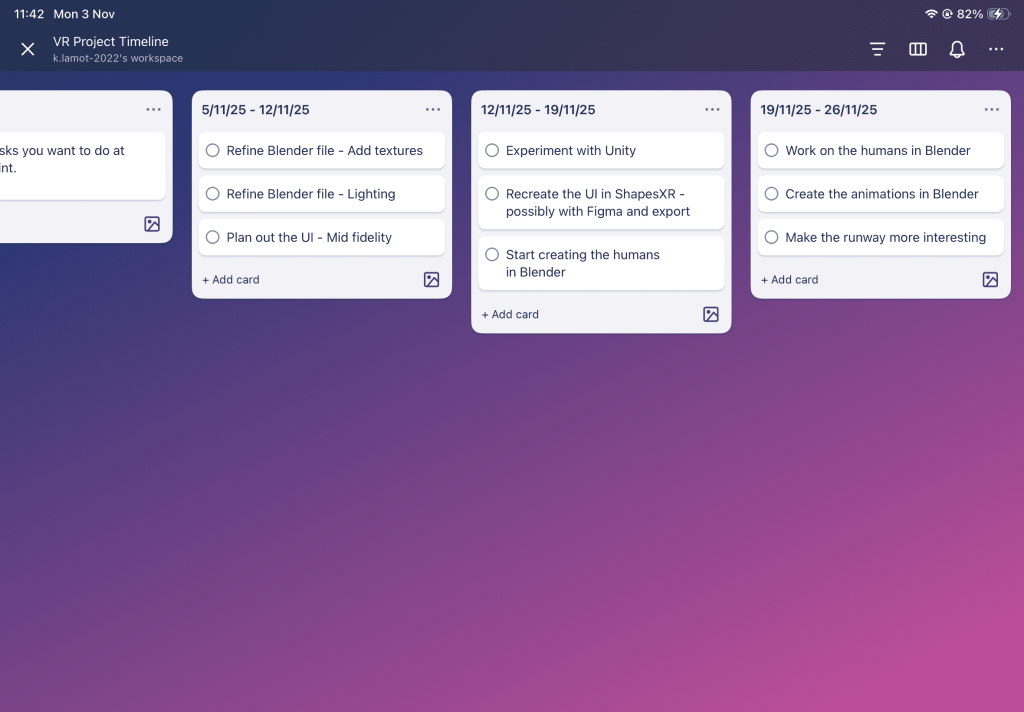
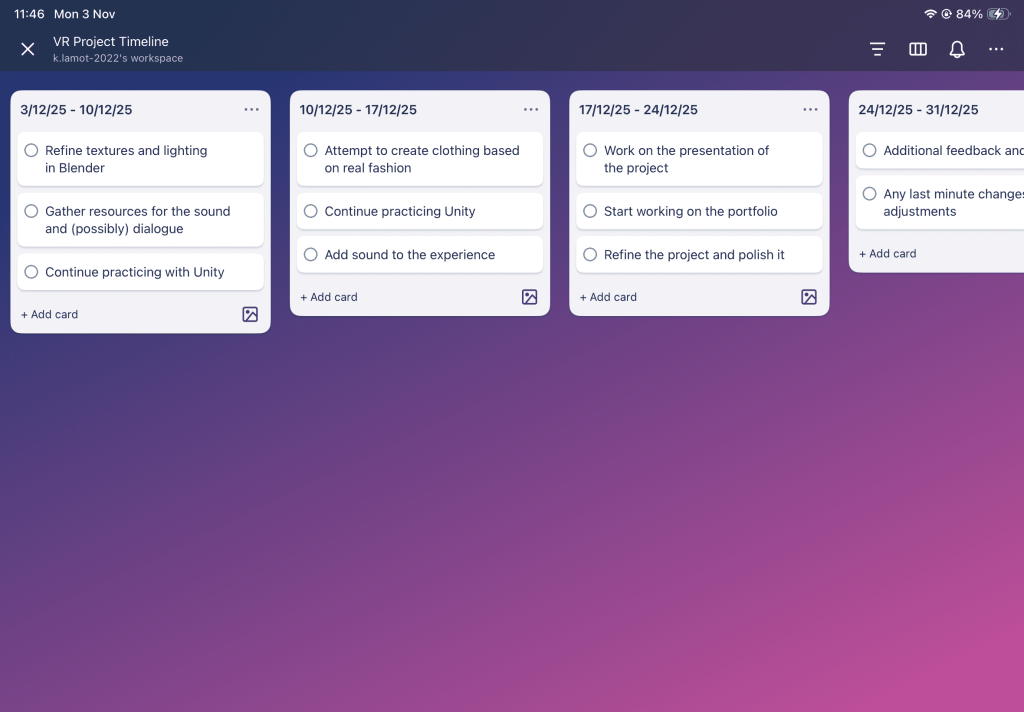
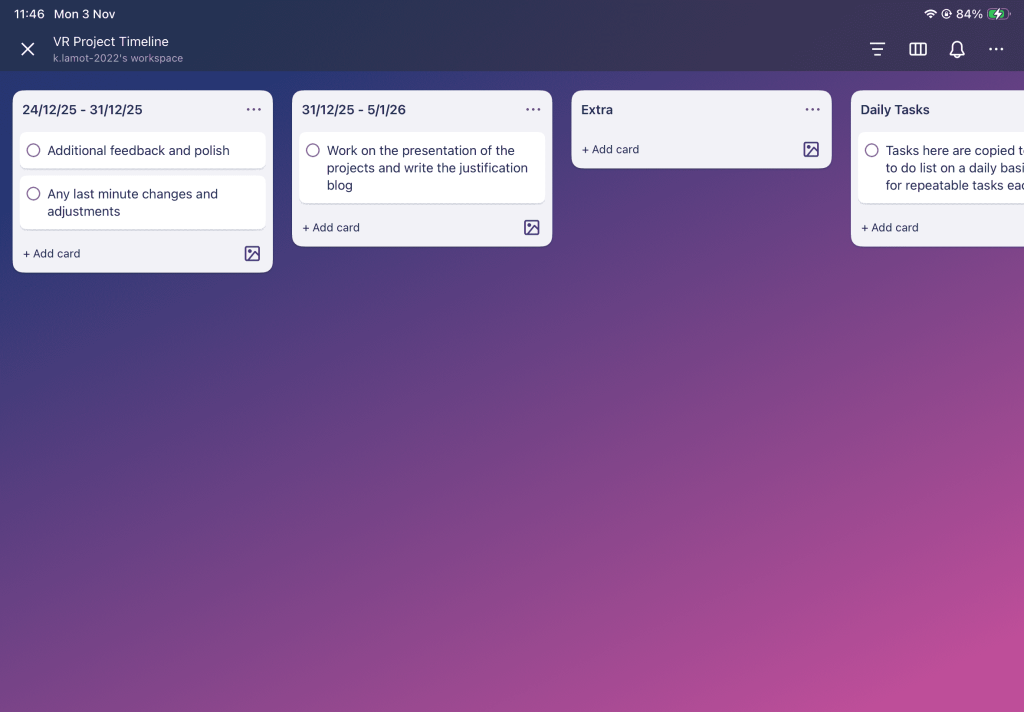
The app that I have used to organize my tasks is Trello because I found the interface of the app more user friendly than Miro and I have decided that it would make it easier for me to keep track of the tasks and update as I make progress through the project in a more cohesive way. When planning the project timeline, I have decided to split it into weeks as it is enough of a time frame to see some sort of progress in between stages.
Time Frames
I have created a Gannt chart in order to plan the overall timeframe of this project and at which points I should be focusing on each stage. I have taken consideration of the deadline and tried to plan my time around it – as I am currently at the research and planning stage, I am expecting to be design the project in the next coming weeks. Additionally, I have made sure that there is some overlap in between the stages so that I can go back and change anything that did not work out according to the plan without having to start from scratch.
User Stories
“As a fashion enthusiast, I want to experience fashion shows in a virtual world so that I can access it without the exclusivity of the ticket prices and VIP privileges in real life shows.”
“As a fashion/textiles student, I want to experience fashion shows through a new lens so that I can gain new information and research into how the field can be innovated technologically in the future.”
“As a fashion designer, I want to experiment with new technology to present clothing to a potentially new audience so that a wider range of people can interact with my work meaningfully.”
These user stories have helped me in planning and organizing my project because they clearly state the needs of the potential user base and helps me focus on the specifics that would make the experience purposeful for them.
Concept Storyboard
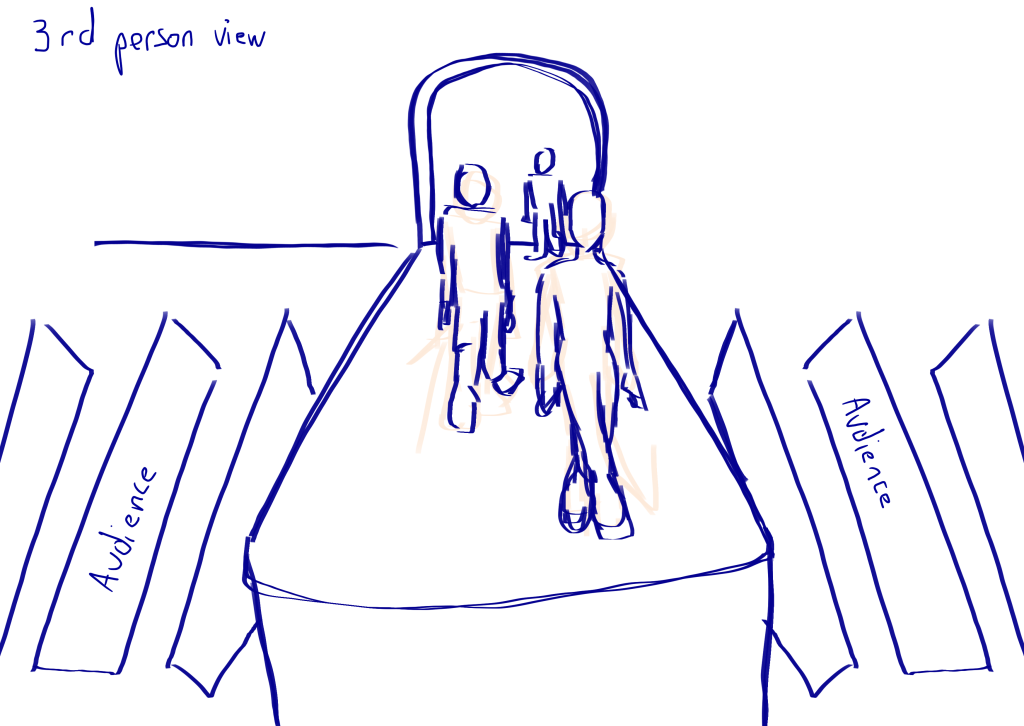
This is the first rough sketch I have created in order to experiment with this idea. As can be seen, this sketch presents the experience from a 3rd person perspective, which is something I have decided against later. I have also thought about other models entering the stage and I am still considering somehow incorporating it into my immersive experience.
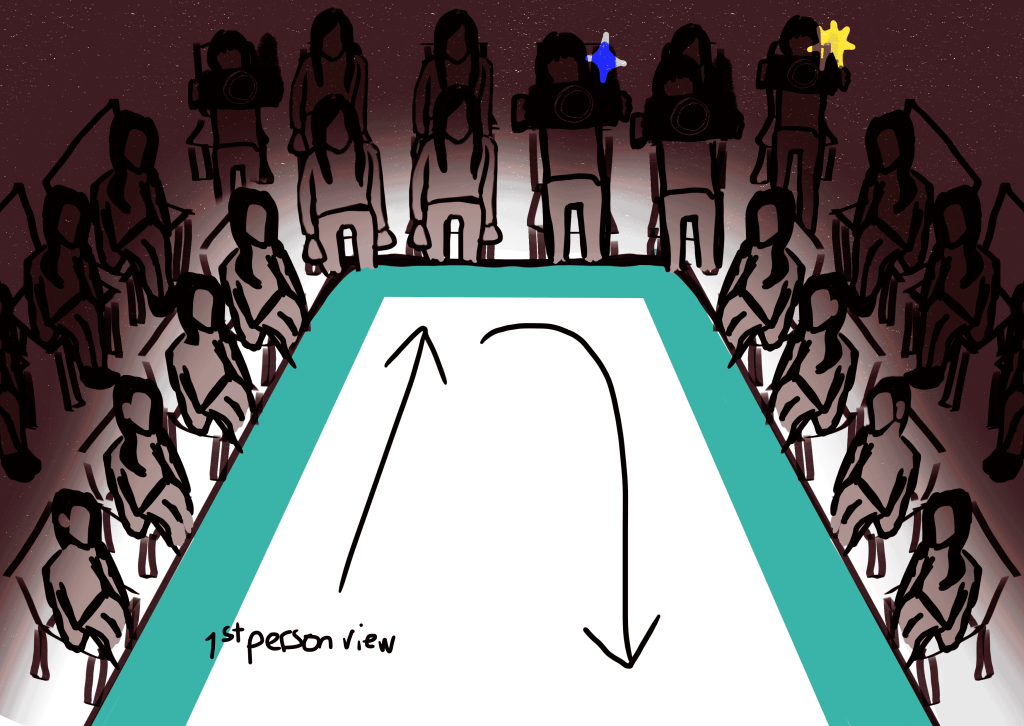
The first storyboard that I have sketched focuses more on the environment and atmosphere of the scene. I have tried to capture a sense of eeriness and a helpless lack of control for the user – I have tried to achieve that through using this specific colour palette and the shadows that cover the corners of the users’ view no matter where they look. The reason why I have done this is to emulate the visual effect some may get in their vision when they panic, however this overlay would depend on the feeling of the character, and it would disappear towards the end.
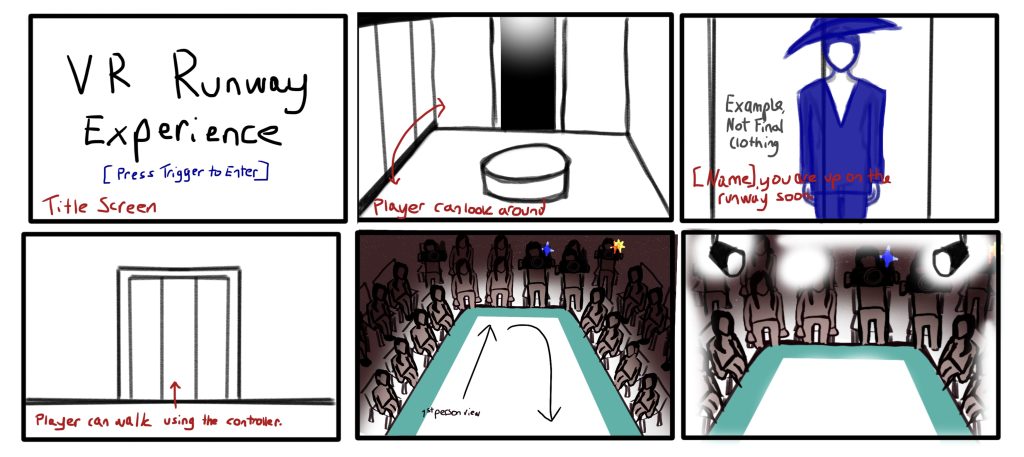
The actions and interactions that happen in this project have been labelled in this storyboard – I have tried to focus on the pure interactivity in this sketch in order to test whether it would work as an actual VR experience whilst I’m at an earlier stage of development. The first panel is meant to present the title screen. I am intending for there to be a button the user has to press to enter the scene. When designing the UI for this, I would make sure there are settings that the player can adjust before starting.
In the second panel, I have sketched the player looking into the full-wall mirror and scanning the outfit they are wearing, possibly being made aware that they are representing a high-fashion brand and that they should try their best to avoid any mistakes whilst modelling these clothes. I am intending the user to feel slight anxiety and also a sense of opportunity due to the fact that most people do not get the opportunity to model at a fashion agency that has such high stakes.
The later panels show the model walking through the rooms and onto the runway, and whilst they are on the runway, the lights also blind them slightly. I have tried observing videos from the perspective of a model walking onto the runway and then exaggerated it slightly and applied the effects of anxiety on their senses.
According to Brument, Pace, & Podkosova (2024), a low-quality but realistic representation of the players resulted in higher embodiment than virtual avatars. One way in which this finding has influenced this project is that I am still trying to experiment with how the player should be represented in the VR experience. Although I do want the player to be able to see their clothing in the mirror reflection, I still need to explore what is technologically available and realistic if I want to achieve the most successful results.
Sound
My plan for the sound in this project is to incorporate sound that is realistic to its surroundings in order for the user to get fully immersed. If the visual or aural stimuli was unrealistic, it could cause a break of immersion and possibly confusion if it isn’t executed purposefully. In addition, another type of sound that would be present in this experience would be quiet music, cameras flashing, talking and footstep sounds that would increase in volume as their stress increases.
Mock 3D Up Model (Work in Progress)
I have started to model the runway for this project so that I can have a headstart and to allow myself more time to make adjustments to the Blender file so that it can convey its purpose properly. I have created a rough model which is meant to map out the space, texture and lighting so that I can experiment with different settings to create my planned result.
Reflection & Emerging Tech Justification
The reason behind me selecting VR as the type of emerging technologies I want to use for this project is that it allows for a lot of versatility in terms of design – every sense has to be considered when designing a VR experience and it can cause a wide array of reactions and experiences from the users. I believe that choosing this medium is the right decision because it will give me experience in a field that has received massive growth over the past decade and it might continue to expand in the future where it will be considered a valuable skill in many careers.
This technology can be considered as emerging because although it is still in its earlier stages of adaptation, by 2027, Statista (2025) predicts that the number of VR users will exceed 100 million. This therefore means that the userbase will increase so the demand for it will increase too.
This project and the technology it uses can be deemed as innovative due to the fact that I am intending to create something entirely new that there aren’t existing examples of, as well as the fact that emerging technologies can be still considered quite experimental in terms of development and design.
References
- Kim, S., J. (2023) Virtual fashion experiences in virtual reality fashion show spaces. Frontiers in Psychology, 14(1-13). DOI: https://doi.org/10.3389/fpsyg.2023.1276856
- Farshid, M., Paschen, J., Eriksson, T., Kietzmann, J. (2018) Go boldly!: Explore augmented reality (AR), virtual reality (VR), and mixed reality (MR) for business. Business Horizons, 61, 5(657-663). DOI:https://doi-org.hull.idm.oclc.org/10.1016/j.bushor.2018.05.009
- Cho, M., Ko, E. (2024) Virtual reality luxury fashion show: how imaginary space influences brand word-of-mouth. International Journal of Advertising, 44, 7 (1175-1194). DOI: https://doi-org.hull.idm.oclc.org/10.1080/02650487.2024.2419227
- Jung, J., Yu, J., Seo, Y., Ko, E. (2021) Consumer experiences of virtual reality: Insights from VR luxury brand fashion shows. Journal of Business Research, 130 (517-524). DOI: https://doi-org.hull.idm.oclc.org/10.1016/j.jbusres.2019.10.038
- Morotti, E., Stacchio, L., Donatiello, L., Roccetti, M., Tarabelli, J., Marfia, G. (2021) Exploiting fashion x-commerce through the empowerement of voice in the fashion virtual reality arena. Virtual Reality, 26 (871-884). DOI: https://doi.org/10.1007/s10055-021-00602-6
- Hong, Y., J., Park, S., Ha, S., Kang, J., Y., Koo, S. (2025) Design characteristics, preferences, and satisfaction toward virtual fashion using augmented reality. International Journal of Fashion Design, Technology and Education. DOI: https://doi.org/10.1080/17543266.2025.2480788
- Statista (2025) Virtual reality statistics. https://www.statista.com/chart/28467/virtual-and-augmented-reality-adoption-forecast/ [Accessed 1/11/2025].
- Brument, H., Pace, F., D., Podkosova, I. (2024) Does mixed reality influence joint action? Impact of the mixed reality setup on users’ behaviour and spatial interaction. Multimodal User Interfaces, 19(119-138). DOI: https://doi.org/10.1007/s12193-024-00445-w
- Balenciaga (2025) Balenciaga Winter 25 Collection, Immersive Experience [Video]. https://www.youtube.com/watch?v=N01cKox9OHg&t=213s [Accessed 2/11/2025].
- Christian Dior (2017) Spring-Summer 2017 Haute Couture show – 360° [Video]. https://www.youtube.com/watch?v=6feOoJJ4IFw [Accessed 1/11/2025].
Leave a Reply