Negotiated Project Proposal Presentation
Link to PDF of the presentation: http://lamot-2023.hulldesign.co.uk/wp-content/uploads/2025/11/Professional_Portfolio.pdf
The Project Brief
Link to PDF with better quality: Creative_Brief-w-1_page.pdf
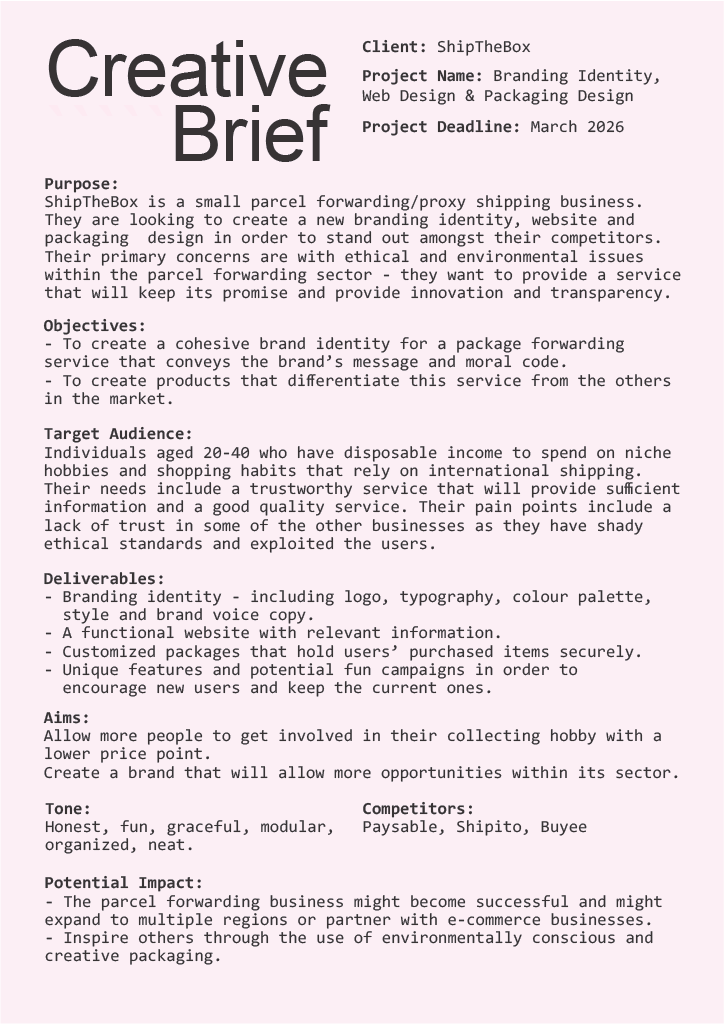
When creating this project brief, I have tried to make it realistic although it couldn’t be fully as this is technically a personal project – I have tried to write it in the way that a client (small business) would when asking a graphic designer to work with them on a project. The name of the company is a placeholder as I have not fully decided on a name yet at this early stage of the project.
Reasoning for Project
The reason behind creating a new brand that focuses on proxy package shipping is to allow users from countries with more restricted shipping access to have more variety of choice in shopping online. The competition for this business sector highly depends on the region it is based around; for example,there is higher amount of demand for proxy services for products from countries such as United States, Japan and France therefore there will be more choices for them in terms of competition. The one problem I am currently having is deciding on which country to focus on as that would change how the branding looks as it would be targeting different audiences. However, if I were to provide proxy services for multiple countries, one of the outcome ideas I had for the packaging is to include a different signature for different countries and to have different designs for them.
Moodboard - Figma (multiple pages)
I have created a Figma file for this project which is meant to be where I organize all of my inspirations and ideas into one place, which is useful in terms of keeping the sources organized. I have created two pages – the first one shows my initial moodboards whereas the second presents the books that I am going to take inspiration from. I am planning on using this tool to keep my project updated and to have a singular place to place sources from different mediums. This is the early iteration of the source documentation.
Stakeholders & Business Types
- When thinking about this project, I have tried to split the different stakeholders and audiences in order to decide on who should be prioritised. Some of the different types of businesses are:
- B2C – The most common type of business. The businesses forward the packages to individual customers who use their service.
- B2B – Business to business. These companies mass send products to other countries in order to save on shipping costs in the long run.
- Individual Online Sellers. These small businesses are based on one person who will provide the service of shipping products from their country to the country of the buyer. They usually operate on social media such as Reddit and Instagram however in rare cases they might set up their own website to stand out amongst competition.
References in the Presentation
Websites
- Juetten, M. (2019) Failed Startup: Shyp [Blog post]. https://www.forbes.com/sites/maryjuetten/2019/01/24/failed-startups-shyp/ [Accessed 28/10/2025].
- ParcelLink (2025) Invest in packaging to save money [Blog post]. https://www.parcel-link.co.uk/blog-entry.php?article=110 [Accessed 28/10/2025].
- Warehousing And Fulfillment (2025) How international businesses should approach parcel forwarding [Blog post]. https://www.warehousingandfulfillment.com/warehousing-and-fulfillment-resources/international-parcel-forwarding-101-a-beginners-guide/ [Accessed 28/10/2025].
- Docshipper (2025) How to prevent yourself from scams in the freight forwarding industry? [Blog post]. https://docshipper.co.uk/en/shipping/prevent-scams-freight-forwarding-industry/ [Accessed 28/10/2025].
- DeliveringParcel (2025) Proxy buying and shipping services. [Blog post]. https://blog.deliveringparcel.com/proxy-buying-and-shipping-services/ [Accessed 28/10/2025].
- Cosmos Board (2025) [Mood board]. https://www.cosmos.so/lovecherrymotion/packaging-ui [Accessed 28/10/2025].
Academic Journals
Hallikainen, H., Laukkanen, T. (2018) National culture and consumer trust in e-commerce. International Journal of Information Managment, 38(1), 97-106. DOI: https://doi-org.hull.idm.oclc.org/10.1016/j.ijinfomgt.2017.07.002
- Soleimani, M. (2021) Buyers’ trust and mistrust in e‑commerce platforms: a synthesizing literature review. Information Systems and e-Business Management 20, 57–78. DOI: https://doi.org/10.1007/s10257-021-00545-0
- Xiao, B., Benbasat, I. (2011) Product-related deception in e-commerce: a theoretical perspective. Management Information Systems Research Center, 35(1), 169-195. DOI: https://www.jstor.org/stable/23043494
- Kim, Y., Peterson, R. (2017) A Meta-analysis of online trust relationships in e-commerce. Journal of Interactive Marketing, 38, 44-54. DOI: https://doi-org.hull.idm.oclc.org/10.1016/j.intmar.2017.01.001
- Oliveira, T., Alhinho, M., Rita, P., Dhillon, G. (2017) Modelling and testing consumer trust dimensions in e-commerce. Computers in Human Behaviour, 71, 153-164. DOI: https://doi-org.hull.idm.oclc.org/10.1016/j.chb.2017.01.050
- Steenis, N., Herpen, E., Van der Lans, I., Ligthart, T., Trijp, H. (2017) Consumer response to packaging design: The role of packaging materials and graphics in sustainability perceptions and product evaluations. Journal of Cleaner Production, 162, 286-298. DOI: https://doi-org.hull.idm.oclc.org/10.1016/j.jclepro.2017.06.036
Leave a Reply