Task 1
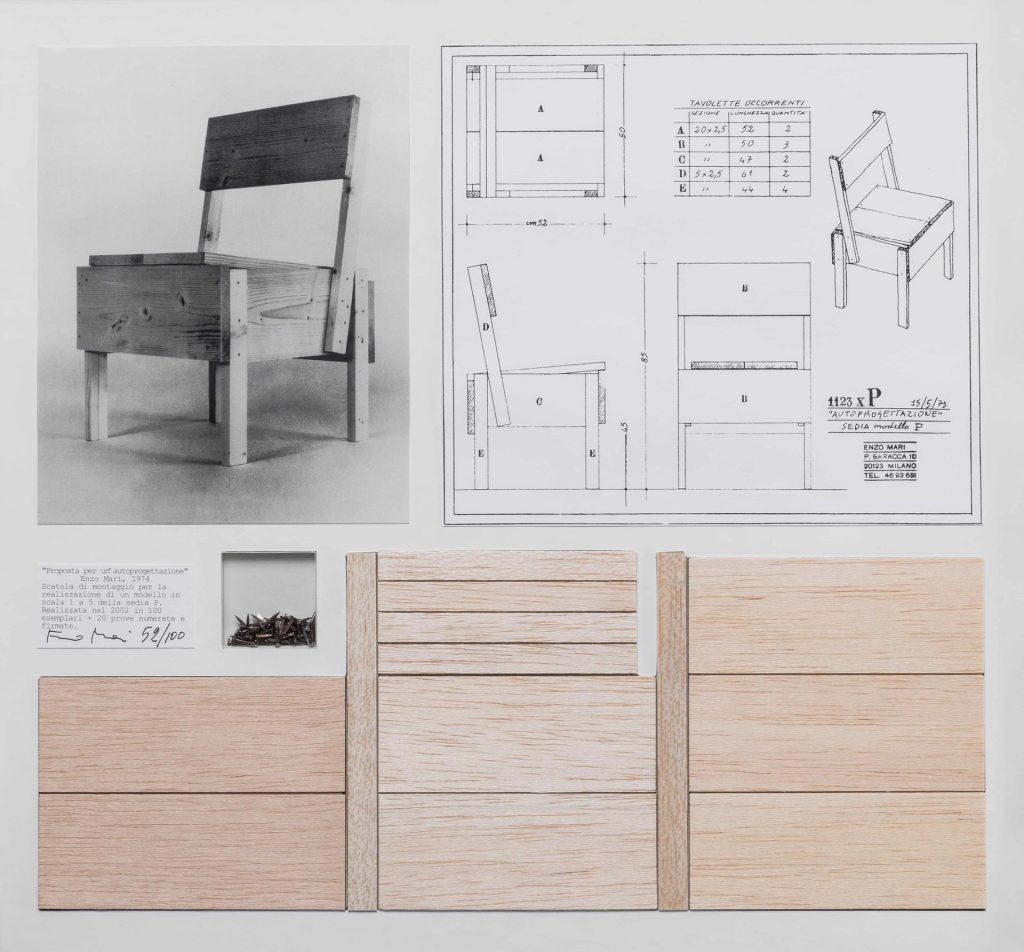
Enzo Mari is a modernist graphic and industrial designer who tried to link design with utility and also a focus on benefits for the designer as well as the consumer. One book/documentation that he has created (“Autoprogrettazionne?”, 1974) focuses on teaching people without wood-working/furniture building experience how to build simple furniture with a small amount of materials and without a focus on decoration, but rather on pure utility. The diagrams drawn and designed in this book are precise and allow the reader to see the proportions properly as measurements are incredibly important in building and designing furniture – these clear diagrams ensure that the readers can have a better understanding of this craft even if they did not carry much knowledge on it previously.
One way in which this has provided benefits to society is through providing the tool of knowledge to people who do not have access to super high quality materials and professional design, and also encouraging people to create things out of what they already have instead of contributing to consumerism and purchase of products that aren’t truly needed in life. This is important in the context and era it was created in, as many people struggled financially after the war and as the modernist movement in the post-war era has bloomed into a substantial movement, many people have decided to create art and design that was more purpose-driven and simplistic than the previous eras were.
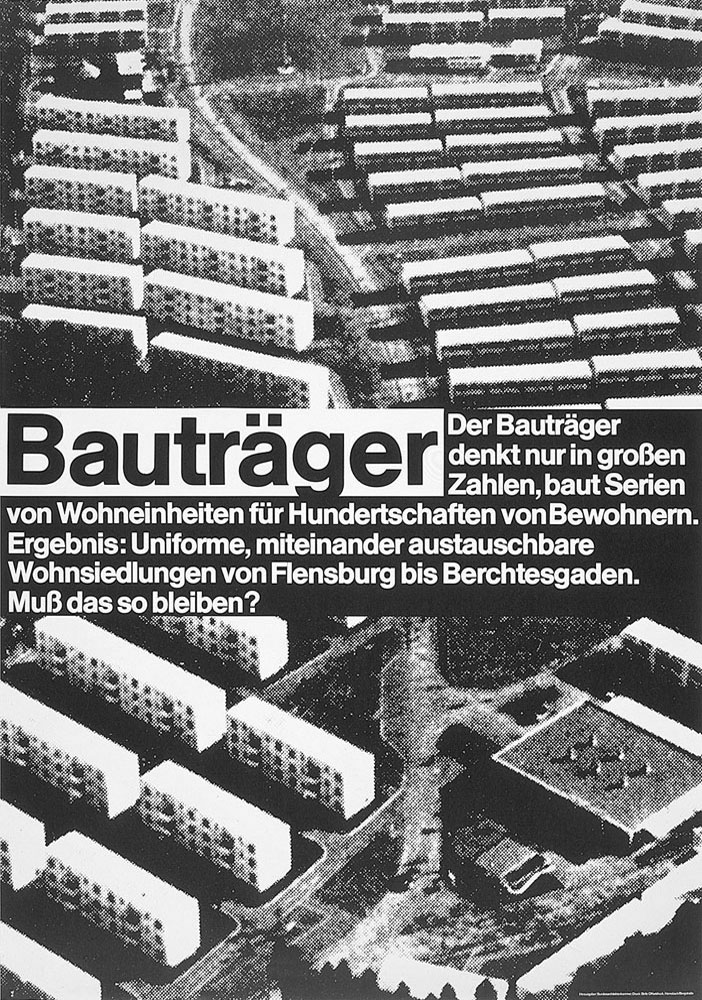
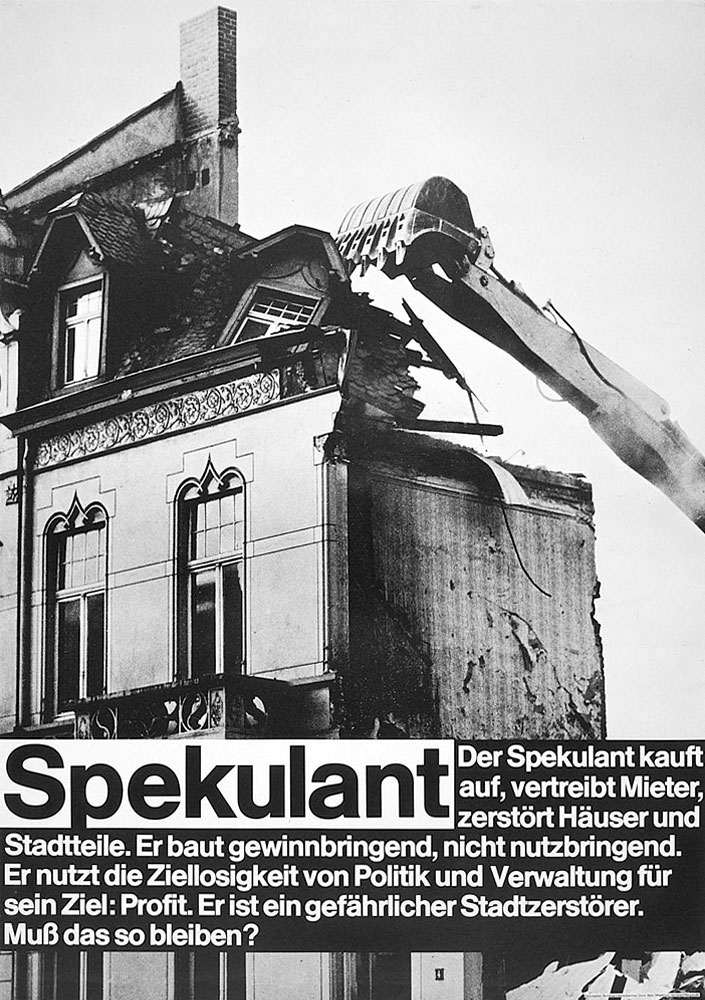
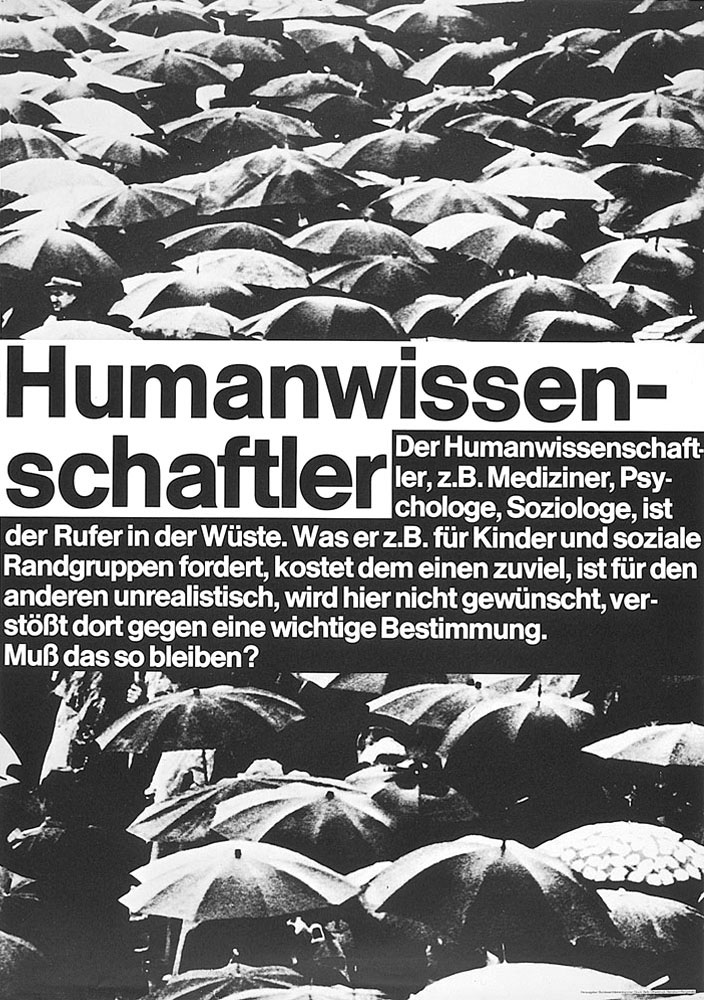
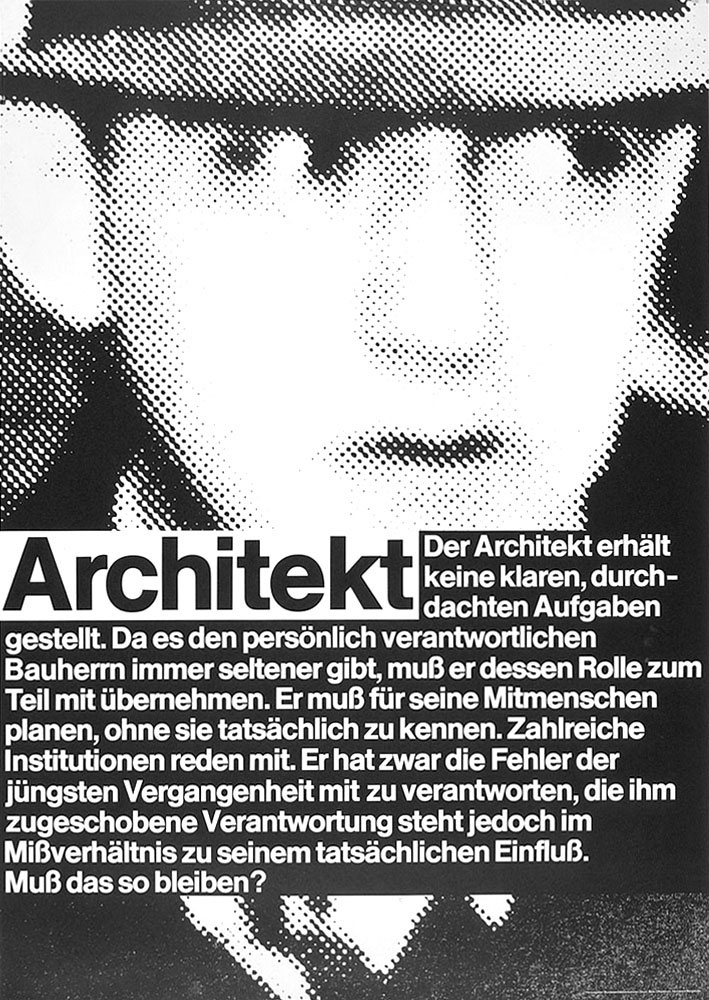
In 1971, Gunter Rambow, a graphic designer, has created a series of posters criticizing the societal and ethical issues associated with urban planning and building construction. He has completed this criticism through asking a question to each participant of the process of urban development, from the architect to the social scientist. These questions are coupled with brutalist typography set in a specific area in a uniform manner to present the question in a serious manner and make people contemplate their place in the societal issues with urban development such as being profit-oriented and not providing much care to the buildings that the poorer side of society live in. One way in which this has had positive impact is through highlighting the injustices that poorly planned housing causes to the underprivileged class – especially in the context of the post-war era where many cities were destroyed and had to be rebuilt. In addition, the contrast between the title that the speaker is addressing and the actual question allows for the highlighting the part in which each of these professions has failed in providing safe, affordable housing to people and therefore should take social responsibility for it and protest for a better outcome.
Task 2
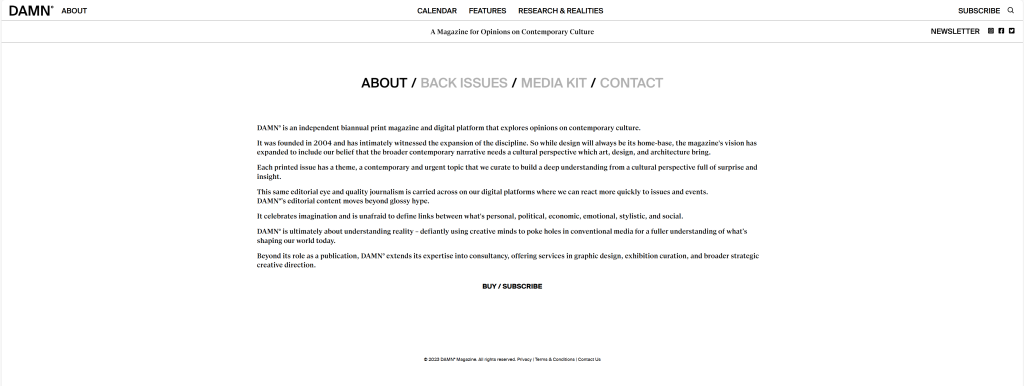
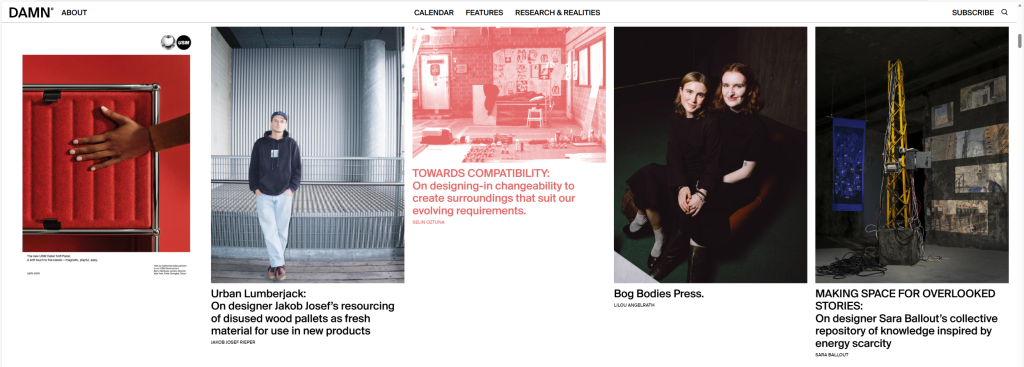
The contemporary design example I am looking to analyse is the DAMN website which is an online magazine providing design and art commentary as well as information on how design can provide benefits for solving societal issues. They also provide a spotlight to artists that discuss pressing societal issues in their work, therefore putting spotlight on artists that link their art with politics, socio-economic problems and many more issues that are not usually tackled by the mainstream media. The layout of the website has resemblance to a brutalist style through its use of minimalist typography and a monochrome palette that prioritizes the art and design they are trying to share with the world. The way in which different stories are presented is in a tile-like layout and the mouse transforms when the user hovers to the left or to the right – this presents the inherent understanding the designer of this website had when creating it as it understands that the user wants to read further into it and click through each image carefully. The way in which this website is presented is generally beneficial in the way that the creators of these new innovations and designs are presented and credited thoroughly – in the current era of generative AI where artists’ and designers’ work is devalued and treated as unimportant labour, this website demonstrates the care that they put in presenting the innovations that humans are still continuing to create to further benefit and improve societal issues.
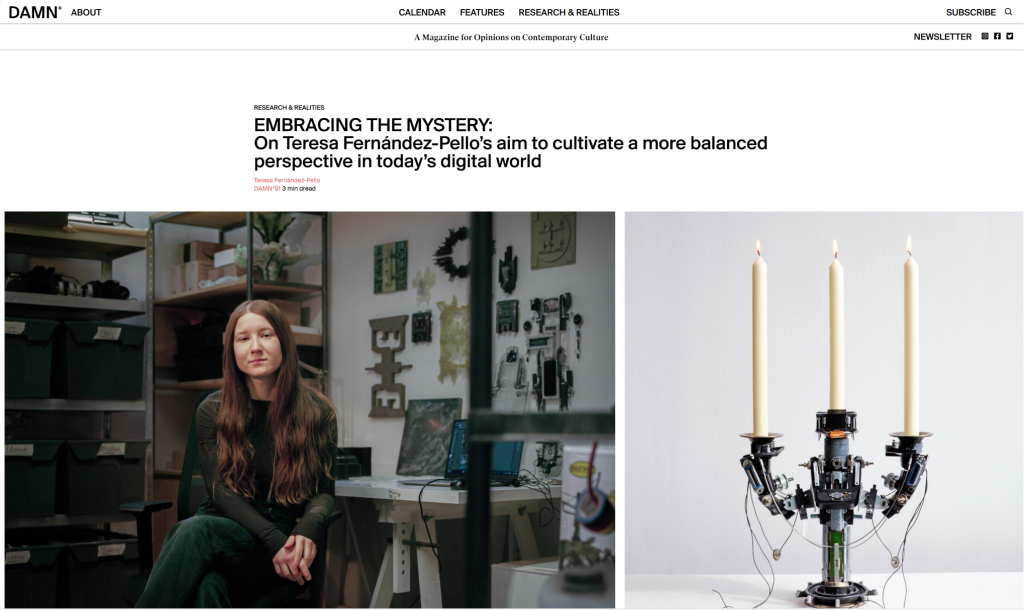

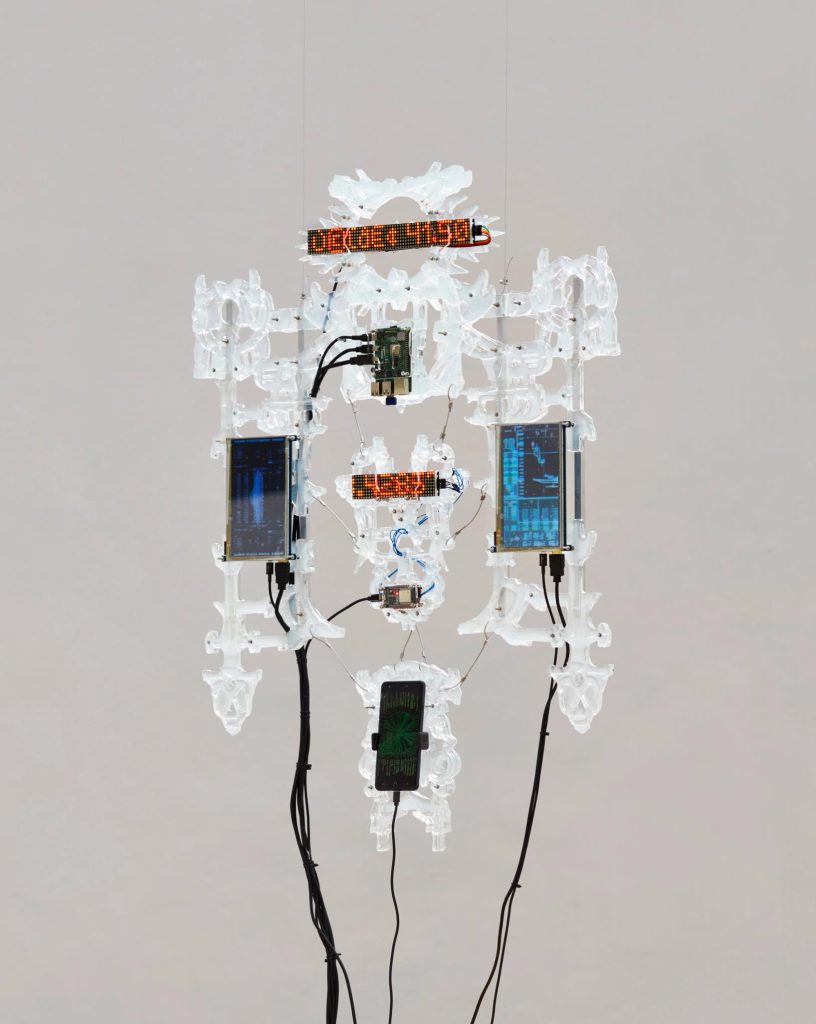
Furthermore, I have selected one article to commentate on as I believe it has a lot of potential to continue discussions of re-using old technology parts to create things such as art installations, which is a sustainable alternative to sending unused technology to a wasteland that has a chance of not recycling them. Although it does not technically fit the criteria of graphic design, I believe its message can be conveyed in different formats, including typography for example, through emphasizing how technology has been tied in an almost religious manner to the average person and the problems it can potentially cause. This artist, Teresa Fernández-Pello, has created a series of art installations that use computer components in unusual contexts such as a candle and a sculpture in order to deaccelerate technology and the role it has in consumerism (e.g., overwhelming focus on technology everywhere and how unescapable it is) through using a computer’s processes in objects that have been used by humans for centuries. This has brought me inspiration due to the fact that it has a lot of potential for communicating the message of these computer processes being comparable to human behaviour and how it can be used for the benefit of the environment.
Task 3
Whilst beginning the work on the major project, we were tasked with working as a group of graphic designers to think of potential solutions to the problem of: “How can graphic design highlight the benefits of the outdoors and fresh air, and encourage positive societal change in an age influenced by digital technology?”. Additionally, we selected the age group of 14-29 to focus on when creating the potential ideas for this campaign as this age range is the most accustomed to screen addiction and this campaign could therefore provide real benefits to this audience as they are the most affected by this issue.
We have tried to think of potential design solutions for this problem and this audience through looking at how other designers have tried to combat this issue and tried to select some elements of different campaigns and designs – an example of this being web design used to encourage people to spend time outdoors as well as art installations that focus on bridging the gap between technology and nature, showing that they can co-operate together to combat the destructive nature that overuse of phones has. Additionally, we have also tried to come up with posters and mock-ups that tackle this issue. I have created a mock-up of a screen stand that would be placed in a city and allow users to interact with it to present information on how much time they have wasted whilst using social media and how much their brain has deteroriated from it. Also, I have created an Instagram ad poster that is meant to be ominous and mysterious to intrigue the user and stop scrolling and therefore think more about their usage of screen time and what other more healthy activities can be done instead.

Additionally, I have used this teamwork opportunity to learn how to collaborate with other designers and how to dissect a brief through different perspectives. I have also created a few more Instagram/general poster mock-ups that could capture the target audience’s attention and make them reassess their reliance on phones. This task has helped me greatly in developing some further ideas and concepts for my own campaign due to the similarity in subject matter and the different approaches that could be taken to engage an audience that usually would prioritise convienience over leaving their own comfort zone.
Task 4
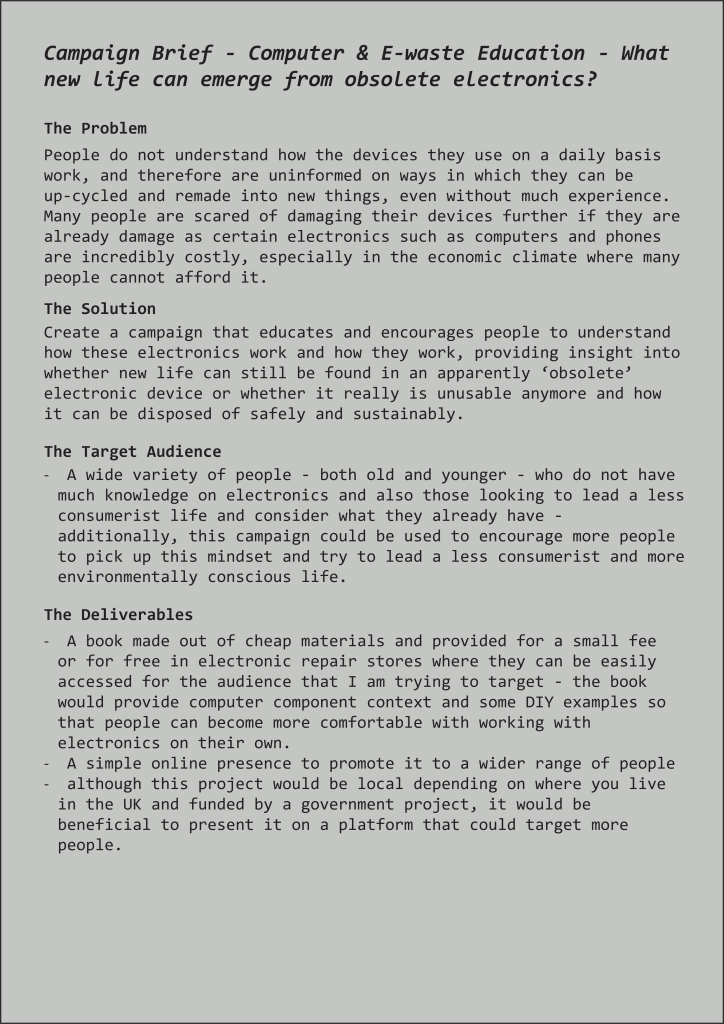
Brief
References
- Socks Studio (2013) Must it stay that way? Critical posters by Gunter Rambow, 1971. https://socks-studio.com/2013/11/29/must-it-stay-that-way-critical-posters-by-gunter-rambow-1971/ [Accessed 17/02/2026].
- DAMN Magazine (2026) Embracing the mystery of Teresa Fernndezpellos aim to cultivate a more balanced perspective in today’s digital world. https://www.damnmagazine.net/embracing-the-mystery-on-teresa-fernndezpellos-aim-to-cultivate-a-more-balanced-perspective-in-todays-digital-world [Accessed 17/02/2026].
- Istituto Marangoni (2024) How Enzo Mari changed design forever. https://www.istitutomarangoni.com/en/maze35/game-changers/how-enzo-mari-changed-design-forever [Accessed 17/02/2026].
- Mari, E. (1974) Autoprogrettazione? Stampato in Italla da
Tlpografla Commerciale, Mantova
maggio 2010. - Kumar, A. (2019) Exploring young adults’ e-waste recycling behaviour using an extended theory of planned behaviour model: A cross-cultural study. Resources, Conservation and Recycling. 141, 378-389. DOI:https://doi-org.hull.idm.oclc.org/10.1016/j.resconrec.2018.10.013
- Jinhui L., Xianlai Z., Mengjun C., Oladele A., O., Ab S. (“Control-alt-delete”: Rebooting solutions for the e‑waste problem.D. N., Perkins, M. B., Drisse, Nxele, T., Sly, D. P. (2014) E-waste: a global hazard. Annals of Global Health, 80(4), 286-295. DOI:https://doi-org.hull.idm.oclc.org/10.1016/j.aogh.2014.10.001
- Widmer, R., Oswald-Krapf, H., Sinha-Khetriwal, D., Schnellmann, M., Böni, H. (2005) Global perspectives on e-waste. Environemtnal Impact Assessment Review, 25(5), 436-458. DOI: https://www.sciencedirect.com/science/article/abs/pii/S0195925505000466?fr=RR-2&ref=pdf_download&rr=9cbe43ff3da8b0fe
Leave a Reply